


Should you build or buy shipping software? A guide for ecommerce teams
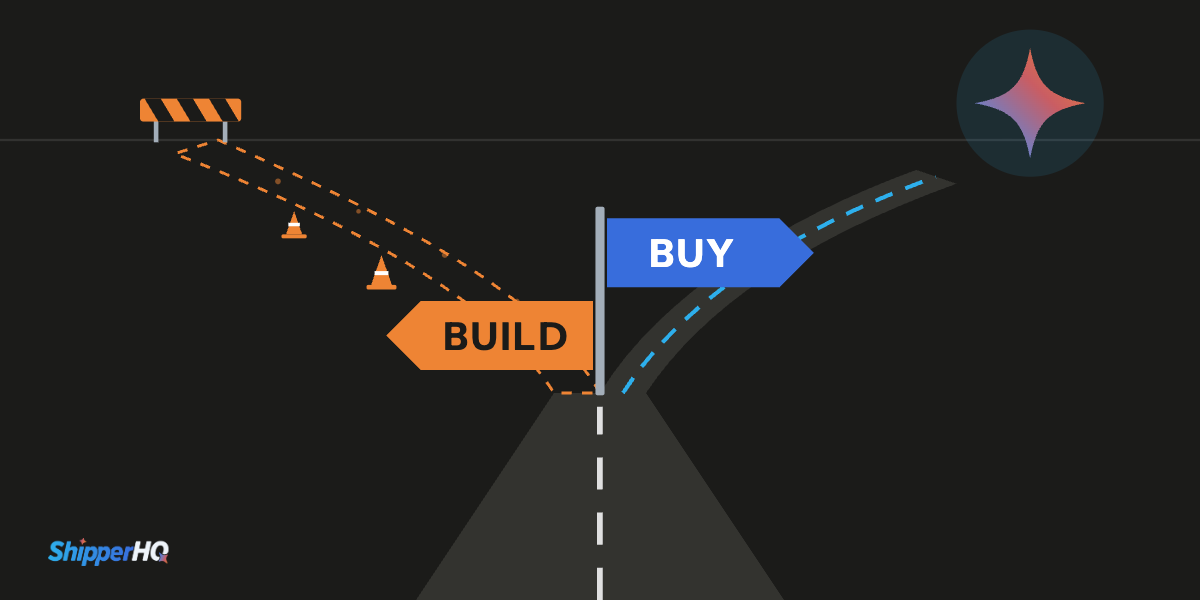
AI tools like Claude are letting ecommerce teams build things they never could before. A product quiz that matches shoppers to the right size. An internal dashboard that pulls sales, inventory, and reviews into one view. A Slack bot that cheers every time an order over $500 comes in. Ideas that used to sit in the backlog waiting for budget and developer time can now become working tools in an afternoon.
So it’s no surprise some teams are considering building their own shipping and checkout tools. At ShipperHQ, we’ll always support that kind of innovative thinking. We exist to help the whole ecommerce ecosystem succeed, and that means helping merchants find the right solution for their business.
AI makes it fast and inexpensive to build a first version of a shipping rate calculator. Keeping it accurate, fast, and secure is ongoing work most teams don’t plan for. Here’s how building and buying compare.
Build vs buy at a glance
|
Build your own shipping software |
Use a no-code shipping platform |
|
|
Cost |
AI tools are relatively inexpensive. Developer time and rate errors add up fast. |
Monthly or annual subscription. Accurate rates keep your shipping costs down and increase conversions. |
|
Time to launch |
Days for a vibe-coded prototype. Months for a production-ready solution. |
Set up and configure your shipping and checkout in less than a week. |
|
Maintenance |
Your developers keep up with every carrier API change, platform update, and security patch. |
The software provider maintains all the carrier integrations, handles every API and platform update, and keeps checkout running fast without downtime. |
|
Security |
Your team owns audits, storing carrier credentials safely, managing access and change history, monitoring, vulnerability scanning, and incident response. |
ShipperHQ runs on enterprise-grade architecture, with weekly vulnerability scans, data encryption, and GDPR compliance built in |
|
Control |
You own the code, but every shipping promo or rule change is likely a developer update. |
Your team gets full no-code control and visibility. Anyone on the team can make shipping changes, with an activity log that shows who did what. |
|
Shipping strategy |
Your team has to monitor checkout performance, keep up with changing customer expectations, and optimize the shipping experience for conversion. |
Shipping experts and AI agents help guide your shipping strategy, monitor checkout performance, and optimize the shipping experience for conversion. |
|
Best fit |
Small stores with simple shipping, or enterprises with large in-house development teams |
Growing stores that have complex shipping needs, know shipping influences the buying decision, or don’t have large developer teams |
To help you decide your next steps, we put together this guide on building vs buying a shipping solution for checkout. You’ll learn what it takes to build your own shipping software, when it makes sense, when an out-of-the-box platform is the better fit, and what to plan for if you do build.
Shipping is a key part of the checkout experience, where shoppers make their final purchase decision. Whether you build or buy, your shipping solution’s primary job is to deliver a fast, reliable, and secure experience for every buyer.
What Does It Actually Mean to Build Your Own Shipping Software?
“Building your own” can mean anything from a weekend script to a full rating engine. There’s a big difference between a custom solution built by an experienced development team and a tool that you vibe-coded over the weekend.
What you can build quickly
With an AI coding tool and a developer guiding it, most teams can get a working first version of the basics:
-
Flat-rate shipping. One rate per order or per method, like $9.99 standard shipping.
-
Free shipping thresholds. Free shipping over a set cart value, with simple exclusions.
-
Simple delivery estimates. “Arrives in 3–5 business days” messaging based on the shipping method, without accounting for real-time transit times, product lead times, or facility cutoffs.
-
A connection to your checkout. Sending rates to your ecommerce platform through its shipping API so shoppers see them at checkout.
What takes significantly more work
The capabilities that separate a prototype from a tool you can trust on every order take much more time to build and maintain:
-
Live rates from direct carrier API connections. Getting API access approved is only the first step. After that, you’re managing credentials and keeping up with API changes across every carrier you use.
-
Carrier rates that stay accurate. Whether you show real-time rates or set table rates by weight, order total, and destination zone, keeping them accurate as your catalog and carriers change gets complex fast.
-
Dimensional packing. Figuring out which items fit in which boxes, then rating on dimensional weight.
-
Multi-origin rating. Rating each item from the warehouse or dropshipper that ships it, then combining the result into one accurate total.
-
LTL freight. Automating the decision to ship parcel or freight, with freight quotes that include accessorials like liftgate and residential delivery.
-
Delivery dates. Cutoff times, lead times, holidays, and blackout dates that reflect your real fulfillment schedule.
-
Backup carriers. Fallback rates that show at checkout if a carrier API goes down.
-
An admin interface and analytics. A way for non-developers to view and change your shipping configuration and see how it’s performing without touching code, plus a log of who changed what.
-
Security and monitoring. Credential storage, access controls, uptime monitoring, and vulnerability scanning.
-
Shipping intelligence. Continuously analyzing your shipping data to find where you’re losing conversions or margin, and how to fix it.
How Long Does It Take to Build Your Own Shipping Software Using AI?
A basic prototype with flat rates and one carrier can come together in a few days. A production-ready tool with multiple carriers, the right shipping rules and packing logic, testing, security review, and an admin interface typically takes weeks to months of developer time. After launch, maintenance never stops: carriers update their APIs, catalogs change, and your platform updates how shipping works. With a homegrown tool, your team has to keep up with all of it. With an out-of-the-box shipping platform, you can have a fully configured setup, customized to your needs, in less than a week.
How Much Does It Cost to Build Your Own Shipping Software Using AI?
The AI tools are the inexpensive part. Claude plans that include Claude Code start at $20/month for Pro and go up to $200/month for Max, and developers can also pay per token through the API with no monthly fee. Paid plans have usage limits, so heavier builds may need a higher tier.
Output tokens, the ones Claude uses when it writes code, typically cost about five times more than input tokens, so heavy custom development gets expensive. In one extreme example, an employee at fintech startup Slash spent more than $80,000 in AI tokens in a single week, after the company encouraged staff to use AI coding tools more.
The real cost is developer time: the hours spent building, testing, and securing the tool, plus the hours each month to maintain it. We cover those hidden costs in more detail below.
The Benefits of Building Your Own Shipping Software
Building an internal shipping solution has real appeal, especially for smaller, bootstrapped teams or teams with developers on staff. The main benefits:
-
Speed to prototype. With AI coding tools, you can build a working prototype quickly.
-
Ownership. You control the code, the roadmap, and what the tool connects to.
-
A fit for today’s product catalog. The logic matches your operational needs right now.
-
One less subscription. The software bill comes off the budget.
For some stores, these benefits are worth it.
The Risks of Building Your Own Shipping Software
To show the right shipping options, rates, and delivery dates, a shipping solution needs a working model of every warehouse, box, carrier, rule, and cutoff time. Building the software is one project, but with the ever-changing nature of eCommerce, it’s not just build-and-forget. Shipping software takes constant maintenance. Keeping it current as the market changes never ends. Get one thing wrong, and you can end up with high cart abandonment or surprise carrier bills.
Risk 1: Homegrown Shipping Tools Require More Maintenance, with Less Visibility and Accountability
Owning the code feels like control. But when you hard-code your shipping rules, origins, routing logic, and shipping groups, every change becomes a development project. A new product line, warehouse, promotion, or carrier service means more development, testing, and redeployment.
If your platform doesn’t integrate with a carrier you use, like a regional or LTL freight carrier, your team has to build and maintain that connection too. Carriers are also updating more often as they move toward dynamic pricing, so your logic has to keep up.
You're also responsible for speed and uptime. Your custom logic runs on every cart, so if it’s slow, checkout is slow. Deloitte found that a 0.1-second faster mobile site lifted retail conversions by 8.4%. If your tool or carrier connection goes down with no fallback, shoppers see no rates at all.
What’s at stake: Every business change turns into unplanned development work, and an outage with no fallback stops sales completely, often during your busiest hours.
How ShipperHQ Keeps Your Checkout Current
ShipperHQ integrates with every major ecommerce platform and 100+ carriers and keeps up with their updates. So when a carrier retires an API or moves to dynamic pricing, or a platform like Shopify changes how shipping works, you don’t need to rebuild anything.
Your whole team can see, audit, and update rates and rules without code, and if a carrier goes down, Backup Carrier Rates keep rates showing at checkout. One example: trueCABLE has run ShipperHQ for nearly a decade with zero downtime.
Risk 2: Checkout Security Becomes Your Job
Checkout is where the money is, so attackers target it. In October 2026, attackers made unauthorized changes to multiple Shopify apps and used them to send shoppers to a fake checkout page that looked like the real one. Shoppers entered their card details, then were passed to the real checkout, so orders still went through. Shopify and the app developers moved quickly to shut it down, in one case within minutes, because security teams were watching for it.
When you build your checkout tools in-house, you own all the security overhead: audits, credential management for every carrier account, access controls and change history, monitoring, vulnerability scanning and patching, and incident response. That’s ongoing developer work on top of the shipping logic itself.
If you use AI to write the code, plan for extra review. When Veracode tested more than 100 AI models on 80 coding tasks, the AI-written code introduced security vulnerabilities in 45% of tasks.
Security gaps rarely show up in everyday user testing, where the goal is to confirm the tool works. Finding them takes dedicated security testing, ongoing scans, and regular audits. A homegrown checkout tool is also one more script your team must document, monitor, and prove is secure every time you’re assessed for PCI compliance.
What’s at stake: IBM’s 2026 Cost of a Data Breach Report puts the average cost of a breach at a record $4.99 million and reports a 56% increase in AI-driven attacks. A gap at checkout can expose card and address data, trigger compliance penalties, lead to chargebacks, and erode customer trust.
How ShipperHQ Handles Security
US-based and UK-based teams with decades of development and security experience give security full-time attention. ShipperHQ runs on enterprise-grade architecture, with weekly vulnerability scans, data encryption, and GDPR compliance built in. Your customer data stays private and is never used for AI training, and the Activity Log records who changed what.
Risk 3: The Savings from Building Your Own Solution Can Turn into Costs
Dropping a subscription looks like savings on paper. But those savings often disappear once you factor in developer time and rate errors.
The biggest cost is your team’s time. Someone has to track carrier updates, manage shipping strategy and code, fix rate discrepancies, and patch security issues every week for as long as the tool runs.
There’s also the opportunity cost. Every sprint spent on carrier APIs and rate logic is a sprint your developers don’t spend on what sets your store apart, like your product experience, site speed, loyalty programs, or new sales channels.
Rate errors cost you too. Shipping is full of exceptions that only become obvious when something goes wrong. The code can work exactly as intended and still get the rate wrong. For example, carriers bill on dimensional weight when it’s higher than actual weight, so a script that only totals up the cart’s weight undercharges the customer, and you pay the difference on every misquoted order. Or consider that multi-warehouse orders often get rated per origin and added together, so shoppers see an inflated cost and abandon the cart. Freight is harder still. Miss a residential address or liftgate requirement, and you get billed for those fees after delivery, often wiping out that order’s margin.
What’s at stake: Every underquote comes out of your margin, and every overquote sends a shopper to a competitor. Across thousands of orders, small errors add up fast.
How ShipperHQ Saves Merchants Money
ShipperHQ lets you build a digital twin of your fulfillment network, so every rate accounts for how orders actually pack, which warehouse ships them, and residential and freight fees. With accurate rates, you’ll recover lost margin and convert more shoppers.
When Eagle Mountain Flag returned to ShipperHQ after trying a low-cost shipping app, it recovered $1,000 a month in shipping margin and cut cart abandonment by at least 30% within a couple of weeks. Another customer, 1800 Ceiling, wrote in a review that ShipperHQ has “saved our customers and my company a tremendous amount of time and money.”
Risk 4: Simple Shipping Logic Breaks at Scale
Entering shipping details on each product is easy for a store with 50 SKUs. With 5,000 SKUs, charging the right shipping cost, adding a surcharge for oversized items, or limiting a carrier for certain products can mean updating hundreds or thousands of products, and any change to the logic itself goes back to a developer.
What’s at stake: Hours lost to manual shipping updates, costly developer time for every logic change, and missed updates that show up as wrong rates at checkout. When you need to move fast, your shipping logic holds you back.
How ShipperHQ Helps You Manage Shipping Logic at Scale
With Shipping Rules, you create a rule once and apply it to any combination of shipping groups, origins, or customer groups. One change updates every product it covers. You can also schedule rules to turn on and off on specific dates, so a holiday promotion starts on time and ends without requiring anyone to remember to switch it off. And if you add a new store or switch ecommerce platforms, ShipperHQ automatically migrates your shipping configuration, so you don’t have to rebuild it from scratch.
Risk 5: Shipping Strategy Falls on Your Team
When a homegrown tool quotes a bad rate or a carrier changes its rules, whoever built it has to fix it. Your team likely has deep expertise in many areas, but if they aren’t shipping experts, costly gaps are likely to emerge.
Developers know code, but most aren’t shipping experts. Questions like which carrier services to offer, where to set free shipping thresholds, or how to quote freight accessorials often fall to a team figuring it out as they go.
What’s at stake: Your shipping strategy stalls at whatever your team already knows, and every new carrier, warehouse, or product line becomes a learning curve on live orders.
How ShipperHQ Helps Guide Your Shipping Strategy
With nearly two decades innovating the shipping and checkout experience, our team offers hands-on guidance from people who know shipping inside and out. Pair that expertise with the AI-powered insights from our shipping intelligence platform, and your shipping strategy and checkout experience can keep up with ever-changing marketing conditions and business needs.
When Building Your Own Shipping Software Makes Sense
Building your own shipping logic can work for some stores, like bootstrapped businesses, new stores testing the waters, and brands with a small, simple catalog. If you’re shipping a handful of standard-size products from one location, a homegrown tool or your platform’s native shipping may be all you need for now.
It can be the right call when:
-
Your shipping is simple and stays that way. You have a small catalog, standard-size products, one warehouse, and few changes ahead.
-
You have developers to spare. Your team can dedicate developers to maintaining carrier connections, rules, and security long term, not just to the first build.
-
Your team knows shipping inside and out. You have in-house experts who can own carrier strategy, rates, and rules as your business grows.
-
You have a truly custom requirement. If your shipping depends on logic no platform supports out of the box, building may make sense. Before you commit, check whether a platform’s API can handle the standard parts, so you only build what’s unique to you.
Think You Need a Custom Shipping Setup?
What feels like a one-of-a-kind requirement is often something a shipping platform already handles. We’ve worked with thousands of merchants over nearly two decades, and ShipperHQ was built to solve even the most complex shipping scenarios, from freight and restricted products to multi-warehouse orders and custom delivery dates. If you’re not sure whether your requirement is truly custom, our experts are happy to review your shipping needs with you before your team takes on a build.
When a Shipping Platform Is the Better Fit
The math changes as your shipping gets more complex. If shipping influences the purchase decision, treat it as a core part of the buying experience, not just a back-end setting. These are the scenarios where homegrown tools tend to struggle, and where ShipperHQ was built to help:
-
Big and bulky products. Oversized items need dimensional rates, freight quotes, and accessorials like liftgate and residential delivery. ShipperHQ Dimensional Packing and LTL Freight rate orders the way they actually pack and ship, so freight fees don’t show up after the sale.
-
Restricted and regulated products. Products that can’t ship to certain states, with certain carriers, or by air need rules that apply to every order. ShipperHQ Shipping Rules limit carriers, methods, and destinations by product, so shoppers only see options you can actually ship.
-
Time-sensitive products. Perishable, made-to-order, and gift orders depend on cutoff times, lead times, and blackout dates. ShipperHQ Delivery Date and Time shows shoppers when their order will arrive based on your real fulfillment schedule.
-
Multiple warehouses or dropshippers. Orders that ship from more than one location need rates that combine origins correctly. ShipperHQ Multi-Origin Shipping rates each item from its origin and shows the shopper one accurate total.
-
Fast growth. New products, warehouses, carriers, storefronts, or a platform migration. For a homegrown tool, each one is a development project. In ShipperHQ, it’s a configuration change.
If your store fits one or more of these, the risks above are worth a close look before you build.
Get Complete Control and Visibility of Your Shipping, Without the Tech Debt
Build vs. buy is a big decision, and it’s hard to make on paper. That’s why ShipperHQ offers a free trial. For two weeks, you can set up ShipperHQ in your live store and see exactly how it handles your products, carriers, and checkout. If you’d rather have a guide, you can also book a 1:1 walkthrough with a shipping expert who will look at your actual checkout with you.
And if you decide to build for now, that’s okay. When your catalog grows, you add a warehouse, or your homegrown tool starts taking more time than it saves, we’re happy to talk through whether it’s time for a bigger solution. Yakima Chief Hops, for example, originally built its own shipping setup, then moved to ShipperHQ as the business grew.
When you’re ready, here’s why merchants choose ShipperHQ:
-
Your developers are off the hook for the infrastructure. ShipperHQ handles the shipping infrastructure that changes constantly, including carrier APIs, rate updates, security, and uptime.
-
You stay in control without code. Your team updates your shipping configuration in ShipperHQ, no developer tickets required.
-
You can still build what’s unique. If you need a custom experience, your developers can build on ShipperHQ through the API and SDK and focus on what sets your business apart.
-
You get a deep feature set from day one. Dimensional packing, multi-origin rating, LTL freight, delivery dates, and shipping rules are ready to configure, not waiting on your backlog.
-
You’re backed by 18 years of shipping expertise. ShipperHQ serves 6,000+ merchants in 150+ countries and powers 1 million+ checkouts per day.
-
You’re up and running fast. Set up and configure ShipperHQ in less than a week with help from a 5-star support team, compared to a months-long build.
See why merchants choose ShipperHQ.
Still Deciding Build vs. Buy? Let’s Compare Notes
Maybe you’re three prompts deep into a Claude Code session. Maybe you’re still sketching your dream checkout on a napkin. Either way, we’re happy to talk it through.
Book a no-pressure call with one of our shipping experts. We’ll look at your products, carriers, and checkout, walk through what it would take to build versus what ShipperHQ handles out of the box, and give you our honest take. If the answer is “build it yourself,” we’ll say so. We’ll just ask that you give us a call when SKU number 5,000 shows up.

Share this article
Related Articles

How to Build an Amazon-Like Checkout Experience for Your Store
Imagine you’re hosting a dinner party this Saturday. For the occasion, you order a set of engraved steak knives and ...

Shopify Fall '26 Edition: 6 Shipping Updates Merchants Need to Know
TL;DR: Shopify’s Fall ’26 Edition, Exponential, brings changes to how shipping is managed and displayed at checkout. ...

How to Block P.O. Box Addresses at Shopify Checkout
The order came in just like any other. Payment went through, the customer picked a shipping method, and everything ...