


Precise delivery date estimates are often the deciding factor in completing a sale.
62% of consumers say an accurate estimated delivery date is more important than fast shipping. When delivery expectations are met, it builds trust, leads to repeat business, and helps shape a better customer experience. When they are missed, the cost shows up fast: more “Where’s my order?” tickets, lower customer trust, and fewer repeat purchases.
The tricky part is that delivery date accuracy is not just about what the carrier says. It depends on the full path from checkout to doorstep: carrier transit times, warehouse cutoff rules, fulfillment processing time, inventory location, holidays, peak-season volume, and the channel where the customer saw the promise.
When any of those inputs are wrong, the delivery date shown at checkout becomes a promise your operation cannot keep.
In this article, we’ll cover five common mistakes ecommerce merchants make when calculating delivery date estimates, how those mistakes show up in the customer experience, and how to fix them before they become support tickets.
What Delivery Date Accuracy Actually Means for Ecommerce Merchants
Delivery date accuracy is the percentage of orders that arrive on or before the date shown to the customer at checkout.
That is different from carrier on-time performance.
Carrier on-time performance measures whether the carrier delivered within their stated transit window after pickup. Your delivery date accuracy measures whether the package arrived by the date your store promised the customer. That includes carrier performance, but it also includes everything that happens before the carrier touches the package.
That means your delivery date estimate needs to account for carrier transit time, warehouse processing time, order cutoff times, weekends, holidays, blackout dates, inventory location, multi-origin fulfillment, peak-season delays, product-specific handling time, and channel consistency.
A carrier can deliver “on time” by their own standard while your customer still receives the order later than the date your checkout showed. From the customer’s perspective, that is still a broken promise.
For the broader business case on why delivery dates affect conversion and repeat purchase, read why delivery date estimates matter and how to get them right.
5 Operational Reasons Delivery Date Estimates Break Down
Most delivery date problems are not random. They usually trace back to a few operational gaps in how the delivery estimate is calculated.
The good news: these are fixable.
Pitfall #1: Using Carrier Transit Times Without Real-Time Adjustments
The issue: Many ecommerce businesses rely solely on carrier estimated transit times, but this often does not reflect real-world conditions. Severe weather, labor disruptions, regional capacity issues, unexpected volume spikes, and peak shipping weeks can all change what a carrier can realistically deliver.
What this looks like in practice: A static shipping table says Ground takes two business days, so checkout shows “Arrives Wednesday.” But the carrier is running behind in that lane because of holiday volume or a regional weather issue. A live carrier response would show Friday.
The customer sees Wednesday. The package arrives Friday. Support gets the ticket.
The carrier may not have failed. Your checkout just used stale or incomplete data.
The fix: Use live carrier rates and transit times wherever possible. Real-time carrier data gives your checkout a better view of what the carrier can actually deliver at that moment, rather than relying on a static estimate that may only be accurate under normal conditions.
Pitfall #2: Ignoring Warehouse Cutoff Times
The issue: Warehouses have cutoff times. Orders placed after the cutoff usually do not ship until the next business day. If your checkout does not account for that, it may calculate delivery dates as if every order ships immediately.
That is how you accidentally promise same-day handling on an order that is already too late to leave the building.
What this looks like in practice: Your warehouse cutoff is 3 PM. A customer places an order at 5 PM on Thursday. Checkout calculates the delivery date as if the order ships Thursday. In reality, the order ships Friday.
The delivery date is already one day off before the carrier ever picks it up.
This gets even worse on Fridays. An order placed after cutoff on Friday may not ship until Monday, depending on your warehouse schedule. If checkout still calculates from Friday, the promised date can be wildly optimistic.
The fix: Configure cutoff times by fulfillment location and shipping method. If an order misses the cutoff, the estimated delivery date should automatically roll forward to the next valid ship date. That one adjustment can prevent a huge number of avoidable “late” deliveries.
Cutoff logic is not about shipping faster. It is about making sure checkout does the math correctly.
Pitfall #3: Calculating from the Wrong Warehouse or Fulfillment Center
The issue: Merchants with multiple warehouses, stores, dropship vendors, or fulfillment centers often calculate delivery dates from the wrong origin. This usually happens when the checkout estimate is based on a default warehouse instead of the location that will actually fulfill the order.
That works fine when every order ships from one place. It breaks quickly when inventory is spread across multiple locations.
What this looks like in practice: You have an East Coast warehouse and a West Coast warehouse. A customer in Denver orders a product. The checkout estimate assumes the order will ship from the West Coast because it is closer.
But the West Coast warehouse is out of stock, so the order ships from the East Coast. Now the package has a longer transit time than the customer was shown.
The customer does not care that the closer warehouse was out of stock. They care that the date was wrong.
The fix: Use multi-origin shipping logic that determines the actual fulfillment origin before calculating the delivery date. The estimate should be based on the warehouse, store, 3PL, or vendor that will actually ship the order. That means delivery date logic needs to understand origin rules, product availability, and fulfillment priority before it shows a promise to the customer.
This is where multi-origin shipping becomes more than a fulfillment feature. It directly affects checkout accuracy.
Pitfall #4: Forgetting Holidays, Blackout Dates, and Peak Periods
The issue: Delivery date estimates often assume every day is a normal operating day.
Real life disagrees.
Warehouses close. Carriers observe holidays. Teams pause fulfillment for inventory counts. Black Friday and Cyber Monday volume slows down both internal processing and carrier networks. Weather events and holiday backlogs create ripple effects.
If those days are not reflected in your delivery date logic, checkout will promise dates your team cannot hit.
What this looks like in practice: A customer orders right before a holiday weekend. Your checkout calculates the delivery date using normal transit time. But your warehouse is closed Monday, and the carrier is not moving packages on the holiday.
The customer sees a delivery date that ignores at least one non-working day.
Now the order arrives “late,” even though everyone in the fulfillment chain operated exactly as expected.
The fix: Build holidays, blackout dates, and peak-period lead time adjustments into your delivery date calculations. That means blocking dates when your warehouse is not shipping, accounting for carrier holidays, and adding realistic buffers during high-volume windows.
If your operation slows down during BFCM, holiday gifting season, or inventory counts, your checkout should know that before the customer places the order.
Pitfall #5: Showing Inconsistent Delivery Dates Across Channels
The issue: Customers often see delivery dates in more than one place. They may see one estimate on the product page, another in the cart, another at checkout, and another on a marketplace listing. If those dates do not match, trust starts to wobble.
Even if the final checkout date is technically correct, the customer may remember the earlier promise.
What this looks like in practice: A shopper sees “Arrives Tuesday” on the product page. They add the item to cart and see “Arrives Wednesday.” At checkout, they see “Arrives Thursday.”
Now they are wondering which one is real.
If the package arrives Thursday, your team may think the promise was met. The customer may feel like the date kept moving.
The fix: Centralize delivery date logic so every channel and checkout touchpoint pulls from the same calculation. Product page, cart, checkout, marketplace listings, and post-purchase messaging should use consistent rules.
The date may change if the cart changes, the shipping address changes, or inventory availability changes. But it should not change because different systems are calculating the same promise differently.
Consistency is part of accuracy.
How to Measure Delivery Date Accuracy
Before you can improve delivery date accuracy, you need to measure it.
A simple formula:
Orders delivered on or before the promised date ÷ total orders shipped × 100
To calculate this, you need two data points: the date shown to the customer at checkout and the actual delivery date from the carrier.
Once you compare those two numbers across enough orders, patterns start to appear.
If orders placed after 3 PM are consistently late, your cutoff logic is probably wrong. If orders from one warehouse miss more often than another, you may have an origin or processing-time issue. If delivery accuracy drops every November and December, your peak-period lead times are not realistic. If marketplace orders have different results from your website orders, your channel logic may be inconsistent.
A useful internal target is 95% or higher, especially for merchants selling perishables, gifts, high-value products, or time-sensitive items. Below that, you may start seeing more WISMO tickets, delivery complaints, negative reviews, and repeat-purchase hesitation.
The goal is not perfection. Carriers will still have exceptions. Weather will still happen. Customers will still miss signature-required deliveries.
The goal is to make sure your checkout is not creating avoidable misses before the package even leaves your building.
How ShipperHQ Calculates Delivery Date Estimates at Checkout
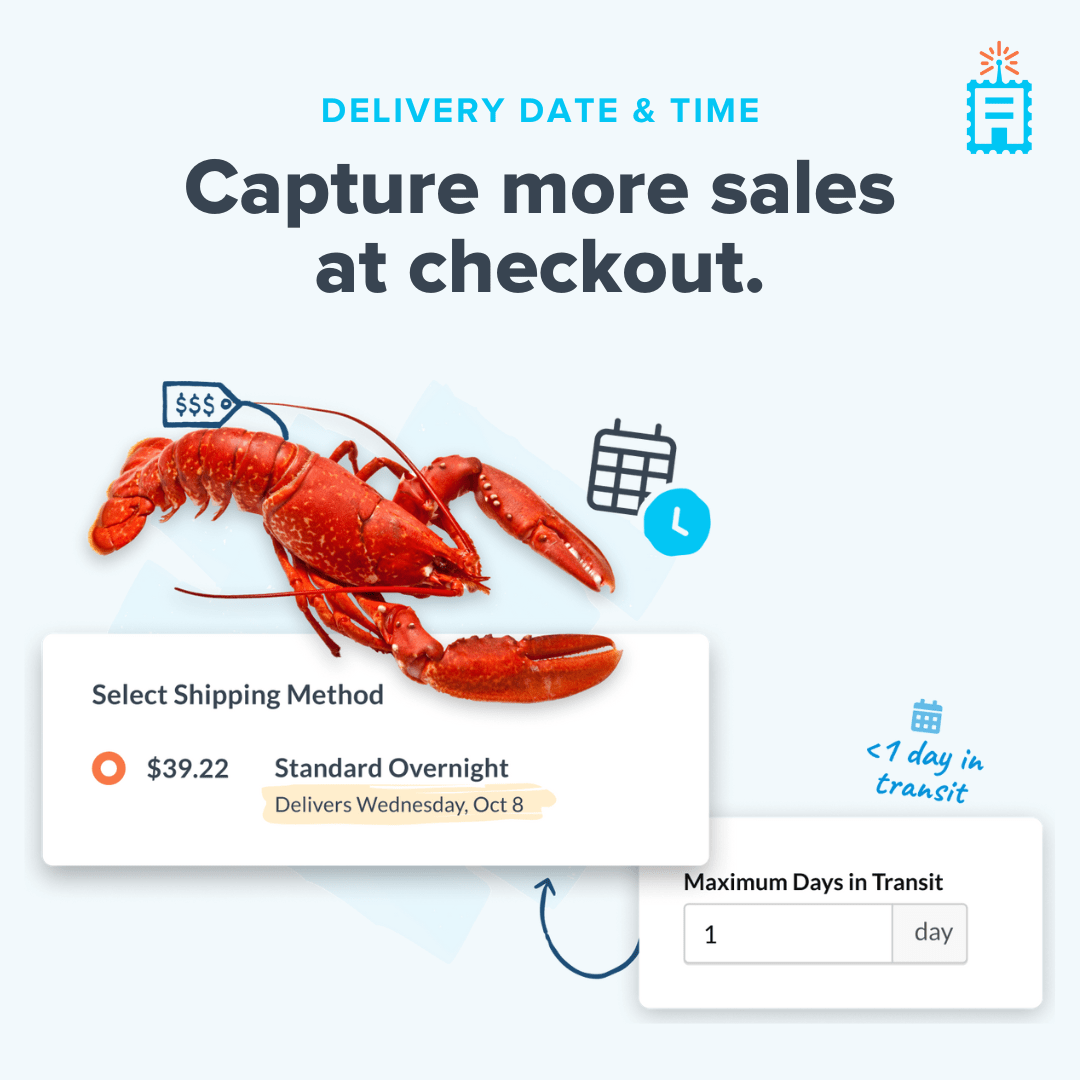
ShipperHQ helps merchants show more accurate delivery dates by combining live carrier data with the operational rules that determine when an order can actually ship.
Here is the basic calculation flow.
First, ShipperHQ checks the order against your cutoff time. If the order is placed before the cutoff, it can ship that day. If it is placed after the cutoff, the ship date rolls to the next eligible business day.
Next, ShipperHQ applies lead times. If a product needs extra processing time, custom handling, or production time before it can ship, that time is included in the estimate.
Then, ShipperHQ checks blackout dates and non-shipping days. Holidays, warehouse closures, weekends, or scheduled downtime can be excluded from the delivery date calculation.
After that, ShipperHQ applies live carrier transit time. The date shown to the customer is based on the service, carrier, origin, and destination involved in the order.
For merchants using multiple warehouses, stores, dropship vendors, or 3PLs, ShipperHQ’s multi-origin logic helps determine which origin should fulfill the order before calculating the delivery estimate. That way, the date reflects the location actually shipping the package, not a default warehouse that may not have the item.
Finally, the estimated delivery date can be shown across the product page, cart, and checkout, depending on your platform and implementation. Using the same logic across touchpoints helps customers see a consistent delivery promise throughout the buying journey.
Each part of that chain matters. A missing cutoff time, skipped blackout date, wrong origin, or static carrier estimate can throw off the final promise.
That is why delivery date accuracy is not just a carrier problem. It is a checkout logic problem.
Delivering on Your Delivery Date Promises
Precise delivery dates are a vital part of your ecommerce store’s success. When customers trust the date at checkout, they are more likely to buy, less likely to contact support, and more likely to come back.
The key is making sure the date is not based on a half-complete calculation.
Carrier data matters. But so do cutoff times, warehouse schedules, fulfillment origins, holidays, lead times, and channel consistency.
ShipperHQ’s no-code shipping solution gives merchants the tools to control those inputs without custom development, so delivery promises can reflect real-world conditions instead of best-case assumptions.
Ready to close the gap between what checkout promises and what actually ships? Try ShipperHQ with a 15-day free trial or book a demo to see how accurate delivery date estimates work in your setup.

FAQs
What is a good delivery estimate accuracy rate for ecommerce?
-
A useful internal target is 95% or higher, especially for merchants selling products where timing matters, such as perishables, gifts, event-based items, or high-value products. The right target depends on your category, shipping methods, and customer expectations. The key is to track delivery date accuracy separately from carrier on-time performance because they are not the same metric.
What is the difference between carrier on-time performance and delivery date accuracy?
-
Carrier on-time performance measures whether the carrier delivered within their own stated transit window after pickup. Delivery date accuracy measures whether the order arrived by the date your store showed the customer at checkout. Your number includes carrier performance, but it also includes your warehouse processing time, cutoff rules, blackout dates, and fulfillment origin.
Do UPS or FedEx estimated delivery dates match what I should show customers?
-
Not always. Carrier estimates usually start once the package is in the carrier’s possession. Your checkout promise also needs to account for when the order will be processed, whether it missed the warehouse cutoff, whether the warehouse is open, and which origin will ship the order. Carrier transit time is one input, not the full calculation.
How do warehouse cutoff times affect delivery date accuracy?
-
A warehouse cutoff is the last time an order can be processed and handed to a carrier that day. Orders placed after the cutoff usually ship the next business day. If your checkout does not adjust for that, customers may see a delivery date that is one day too early before the order has even shipped.
How do multiple warehouses affect delivery date estimates?
-
Multiple warehouses can improve delivery speed, but only if your delivery date calculation knows which warehouse will actually fulfill the order. If checkout calculates from the nearest or default warehouse, but the order ships from another location because of inventory availability, the estimate may be wrong. Multi-origin logic helps calculate the date from the real shipping origin.
Can ShipperHQ show delivery dates on the product page, not just checkout?
-
Yes. ShipperHQ can support delivery date messaging across product page, cart, and checkout experiences, depending on your platform and implementation. Using the same logic across touchpoints helps prevent customers from seeing one promise while browsing and another promise when they are ready to buy.