


Standard shipping delivers in 3–7 business days at a lower cost. Expedited shipping delivers in 1–3 business days at a premium. For ecommerce merchants, the decision isn't which one to offer. It's how to offer both in a way that converts shoppers without compressing margins.
This guide covers how each option works, what they actually cost, how to decide when to use each, and how to configure both at checkout.
At a glance: Standard shipping (3–7 business days) is the baseline for most ecommerce orders: affordable, predictable, and widely available. Expedited shipping (1–3 business days) meets urgency but costs more to fulfill. Offering both, with clear delivery timelines at checkout, reduces cart abandonment and gives customers control over their delivery experience.
What Is Standard Shipping?
Standard shipping is the default option for most ecommerce checkouts. It usually relies on lower-cost ground or economy services and delivers within 3–7 business days for many domestic orders.
How fast is standard shipping?
Transit times vary by carrier, origin, and destination zone:
| Carrier | Service | Typical Transit Time |
| UPS | Ground | 1–5 business days |
| FedEx | Ground / Home Delivery | 1–7 business days |
| USPS | Ground Advantage | 2–5 business days |
These ranges reflect zone-to-zone minimums. Short regional shipments can hit the lower end, but most merchants shipping nationally will see transit times in the 3–7 business day range, which is why that's the standard checkout expectation.
Standard shipping carriers and services
- UPS Ground: domestic ground shipping up to 150 lbs, widely used for small and medium ecommerce packages
- FedEx Ground / Home Delivery: cost-efficient for packages under 10 lbs; Home Delivery covers residential addresses seven days a week
- USPS Ground Advantage: replaced First-Class Package Service, Parcel Select, and Retail Ground in 2023; strong option for lightweight packages under 1 cubic foot, where USPS bills actual weight rather than dimensional weight
- UPS Ground Saver: a lower-cost UPS option for residential deliveries where speed is flexible; worth considering for the right order types. See our guide to UPS Ground Saver for how it compares and where it can reduce costs.
When standard shipping makes sense
Standard shipping is the right default when the order isn't time-sensitive, when your customer is cost-conscious, or when you're offering free or flat-rate shipping. It's easier to manage operationally and keeps costs predictable.
What Is Expedited Shipping?
Expedited shipping prioritizes speed through faster service levels, priority handling, or more direct routing, depending on the carrier and service. It typically delivers in 1–3 business days. The cost premium reflects the faster transit commitment, not necessarily a separate physical handling network.
How fast is expedited shipping?
| Carrier | Service | Typical Transit Time |
| UPS | 2nd Day Air | 2 business days |
| UPS | Next Day Air | 1 business day |
| FedEx | 2Day | 2 business days |
| FedEx | Overnight | 1 business day |
| USPS | Priority Mail | 1–3 business days |
| USPS | Priority Mail Express | 1–2 days (guaranteed) |
| DHL | Express | 1–3 business days (international) |
Note that "expedited" isn't a standardized term across carriers. UPS and FedEx use their own service names. USPS Priority Mail is considered expedited, while Priority Mail Express is the guaranteed overnight tier.
Expedited shipping carriers and services
- UPS 2nd Day Air / Next Day Air: domestic delivery with guaranteed windows; packages up to 150 lbs and 108 inches in length
- FedEx 2Day / Overnight: guaranteed delivery for domestic shipments; strong for both commercial and residential addresses
- USPS Priority Mail Express: guaranteed 1–2 day delivery; includes proof of delivery and is often competitive on price for lighter packages
- USPS Priority Mail: 1–3 business days; not guaranteed but frequently delivers in 1–2 days for shorter zones
- DHL Express: the primary option for international expedited delivery; strong coverage across Europe, Asia, and Latin America
When expedited shipping makes sense
Expedited shipping fits time-sensitive purchases: last-minute gifts, perishables, replacement parts, high-ticket items where customers expect premium handling, and peak periods like BFCM and the holidays. It also works well as an upgrade option at checkout for customers who want control over their delivery timeline.
Expedited vs Standard Shipping: Key Differences at a Glance
Here's a side-by-side breakdown of how these shipping options compare across key criteria:
| Feature | Standard Shipping | Expedited Shipping |
| Delivery speed | 3–7 business days | 1–3 business days |
| Cost to merchant | Lower | Higher |
| Customer cost | Often free or low | Typically a premium |
| Service priority | Economy or ground-based service | Faster service level or time-definite option |
| Best for | Non-urgent orders | Urgent or time-sensitive orders |
| Customer mindset | "I can wait" | "I need it now" |
| Seasonal fit | Year-round | Peak seasons, gifting |
| Margin impact | Predictable | Manageable with the right controls |
How Much Does Expedited Shipping Cost?
Expedited shipping costs more than standard shipping because the carrier is committing to faster transit, priority handling, or a more direct route. The exact gap depends on package weight, dimensions, origin, destination zone, carrier service, and whether the shipment moves by air or ground.
The cost difference is real and varies significantly by lane. A short-zone domestic shipment may see a modest premium. A cross-country shipment moving from Zone 2 to Zone 8 can see a much larger one.
A few factors that affect what you'll pay:
- Distance and zone: the farther the shipment, the larger the gap between ground and expedited pricing
- Weight and dimensions: heavier and larger packages cost more to move quickly
- Surcharges: residential delivery fees, additional handling charges, and fuel surcharges apply to both service types and add up on expedited shipments
- Commercial vs retail rates: carrier accounts and volume agreements lower per-shipment costs compared to retail pricing
For most ecommerce merchants, the right approach is not to absorb expedited costs across all orders. Strategies that work:
- Charge a transparent upgrade fee at checkout (many customers expect to pay more for speed)
- Offer expedited only on orders above a margin threshold or above a minimum cart value
- Restrict it to specific products, SKUs, or categories where urgency is common
- Use shipping rules to show or hide expedited options based on ZIP code, product type, or order value
Is Expedited Shipping Worth It?
For the right orders, yes. The data supports it.
Baymard Institute reports that 20% of shoppers abandon checkout because delivery is too slow, while 40% abandon because extra costs like shipping, tax, and fees are too high. Just having the expedited option visible at checkout can lift conversions, even for customers who don't choose it. The availability signals that you can handle urgency.
Separately, Supply Chain Dive reported that 62% of consumers say an accurate estimated delivery date matters more than fast shipping, citing Pitney Bowes BOXpoll market survey data. That's a useful reminder that speed and clarity aren't the same thing. Shoppers who know exactly when something arrives will often choose standard shipping over an ambiguous expedited window.
The more important question is whether you can offer expedited profitably. That depends less on the carrier cost and more on how you configure the option. Merchants who offer it on everything take the hit on margin. Merchants who offer it selectively, based on product type, cart value, or customer segment, use it as a conversion tool without eroding profitability.
ShipperHQ lets you build shipping rules that show expedited options only when the conditions make sense for your business. That might mean showing UPS 2nd Day Air only on high-margin SKUs, or only for carts above $75, or only within certain zones where the carrier can reliably hit the delivery window.
What's the Difference Between Expedited and Express Shipping?
The terms are used interchangeably by some carriers and have distinct meanings for others, which creates genuine confusion.
As a general rule:
- Expedited typically means 1–3 business days, with faster-than-standard routing but not necessarily a guaranteed delivery time
- Express typically means same-day or next-day delivery, often with a delivery time commitment
In practice, FedEx uses "Express" as the brand name for its entire fast-shipping portfolio: FedEx 2Day, Overnight, and Priority Overnight are all part of FedEx Express. UPS uses "Air" services for its fast tiers. USPS uses "Priority Mail Express" for its guaranteed overnight service.
If a customer asks whether they can get "express" delivery, they're almost always asking whether they can get it faster than standard ground. The answer is yes, and showing them the available expedited options at checkout is the clearest way to respond.
Customer Expectations: The Amazon Effect
Amazon didn't just raise the bar on shipping speed. It changed what customers consider the default. Two-day shipping stopped being a premium option and became an expectation. Now, when a customer sees a vague or unexpectedly slow delivery estimate at checkout, they may hesitate or leave.
This doesn't mean you have to match Amazon. It means you have to communicate clearly.
What modern shoppers want:
- A specific delivery date, not a range like "5–7 business days"
- At least one fast option, even if they don't choose it
- Transparency about what each option costs and when it arrives
- Confidence that what you promise at checkout actually happens
You don't need same-day delivery to compete. You need accurate delivery dates, a credible fast option, and a checkout experience that makes both visible.
How to Offer Both Standard and Expedited Shipping at Checkout
Configuring both options well is more than adding two rate lines to your checkout. The goal is to show the right options for the right orders, not every option for every order.
A well-configured checkout:
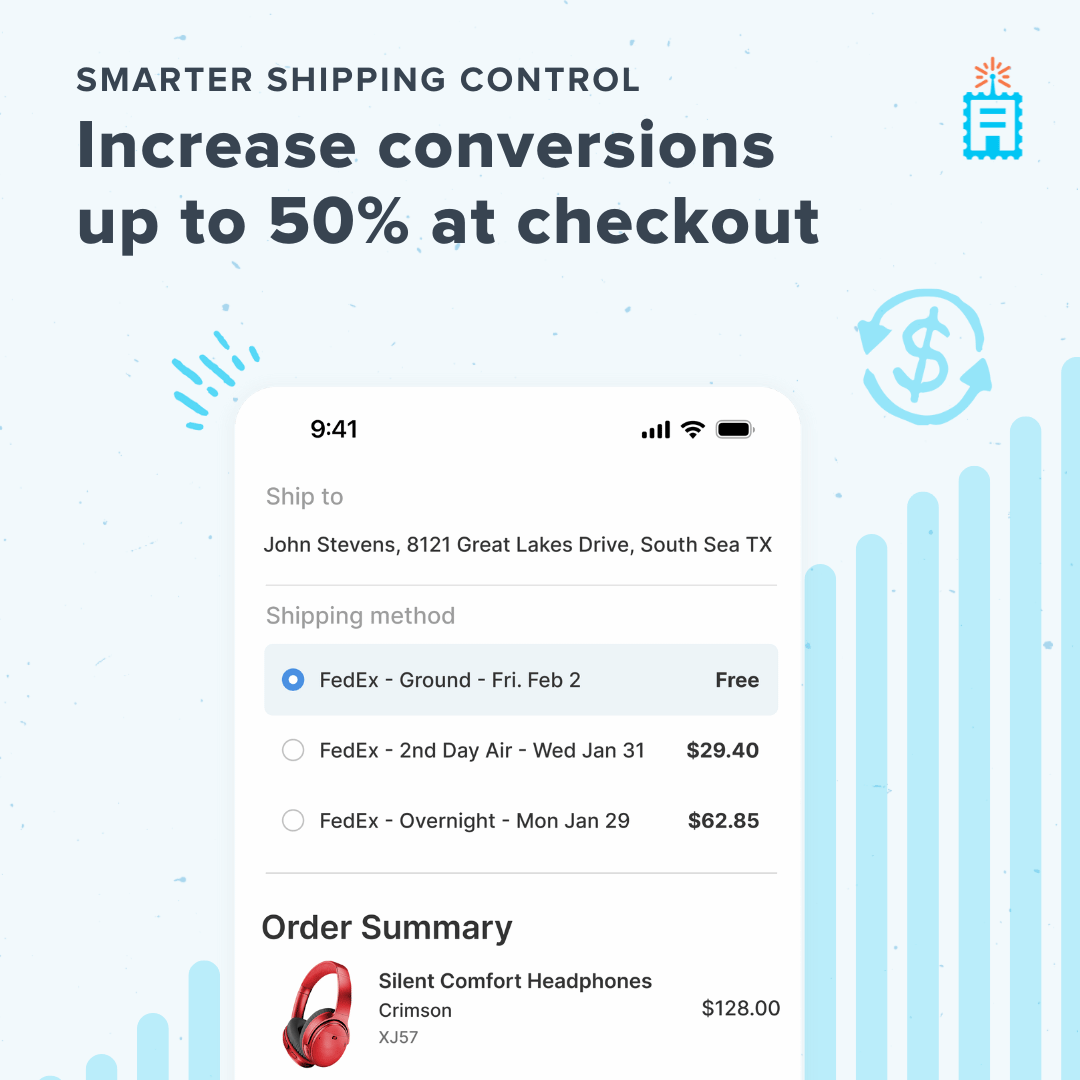
- Shows real-time carrier rates so delivery dates and costs reflect what the carrier will actually charge and deliver
- Displays estimated delivery dates (not just transit times) so customers make decisions based on when the package arrives, not how many days it takes
- Applies shipping rules that control which methods appear based on product type, cart contents, destination, or order value
- Hides or suppresses expedited options for products or destinations where you can't reliably fulfill the promise
ShipperHQ connects to UPS, FedEx, USPS, and regional carriers to pull live rates at checkout, applies your shipping rules automatically, and shows customers estimated delivery dates based on your fulfillment schedule and carrier data. That means customers see shipping options based on live rates, configured rules, and realistic delivery timing, not static guesses.
For merchants currently showing static flat rates, the first step is switching to live carrier rates so the gap between what checkout shows and what the carrier charges closes.
When to Offer Each Shipping Option
Offer standard shipping when:
- You sell non-urgent items: books, home decor, apparel, accessories
- Your customers are cost-sensitive and free or low-cost shipping is a key part of your value proposition
- Your order volume benefits from the operational simplicity of a single service level
- You're building a free shipping threshold and want to keep costs predictable
Offer expedited shipping when:
- You sell time-sensitive products: flowers, perishables, last-minute gifts, event-specific items
- You serve customers who expect premium handling for high-ticket purchases
- You're in a peak season window where delivery speed is a conversion factor
- You want to offer a visible upgrade path at checkout without making it the default
The hybrid approach
Set standard shipping as the default. Let customers upgrade to expedited at checkout. Use shipping rules to make the upgrade option available only when it makes business sense. This keeps your default cost structure intact while capturing revenue from customers who want speed and are willing to pay for it.
How ShipperHQ Helps Merchants Control Shipping Speed and Cost
ShipperHQ helps ecommerce merchants show the right shipping options at checkout, including standard, expedited, same-day, local delivery, pickup, and carrier-specific services.
Merchants can use ShipperHQ to rate shop across connected carriers, apply shipping rules by product or destination, show estimated delivery dates, restrict expedited options by ZIP code or cutoff time, and hide services that are too expensive or operationally unrealistic.
That gives customers useful choices without turning expedited shipping into a margin leak. And it helps shoppers compare speed and cost based on expected arrival, not just vague labels like "standard" or "expedited."
Start a 15-day free trial or book a demo to see how ShipperHQ helps control shipping options, delivery dates, and checkout rate logic.

FAQs
Is expedited shipping faster than standard shipping?
Yes. Expedited shipping usually delivers in 1–3 business days through a faster service level, priority handling, or a time-definite carrier option. Standard shipping uses ground or economy services and typically takes 3–7 business days.
How fast is expedited shipping?
Most domestic expedited services deliver in 1–3 business days. Guaranteed overnight options (UPS Next Day Air, FedEx Overnight, USPS Priority Mail Express) deliver in 1 business day. Two-day services (UPS 2nd Day Air, FedEx 2Day) deliver in 2 business days. USPS Priority Mail delivers in 1–3 business days but is not guaranteed.
How much does expedited shipping cost compared to standard?
Expedited shipping costs more than standard shipping, and the gap widens with distance, package weight, and zone. A short-zone shipment may see a modest premium. A cross-country shipment can see a much larger one. The main cost drivers are carrier service level, dimensional weight, residential delivery surcharges, and any applicable fuel surcharges.
Is expedited shipping worth it for small businesses?
Yes, when it's offered selectively. Offering expedited on every order compresses margins. Offering it on high-margin products, orders above a minimum threshold, or during peak seasons lets you capture conversion benefits without absorbing the full cost increase.
What's the difference between expedited and express shipping?
"Expedited" and "express" are often used interchangeably, but express typically means same-day or next-day delivery. FedEx uses "Express" as the name for its entire fast-shipping portfolio. UPS uses "Air" services. USPS uses "Priority Mail Express" for guaranteed overnight. When a customer asks for express, they're usually asking for the fastest available option.
How do I offer expedited shipping on my ecommerce store?
Connect your store to a carrier account or a shipping platform that pulls live rates. Set up separate shipping methods for standard and expedited options. Use shipping rules to control when each option appears at checkout based on product, cart value, or destination. Display estimated delivery dates alongside each option so customers understand exactly what they're choosing.