

If USPS is part of your shipping mix, the rate you paid a year ago probably isn't the rate you're paying now.
USPS pricing can change through annual service increases, temporary transportation-related adjustments, dimensional weight updates, and package-measurement rules. That's why the headline increase rarely tells the full story. A compact 1-lb package and a bulky 1-lb package can land in very different cost territory once package dimensions, service type, destination zone, and commercial-rate access are factored in.
USPS still has real advantages for ecommerce, especially for small and lightweight residential shipments. Packages at or under 1 cubic foot are billed by actual weight, not dimensional weight, which can make USPS a strong option for the right order. This guide breaks down USPS rate increase history, the services merchants should watch, how dimensional weight affects shipping costs, and how to protect margin with better packaging, rate shopping, and checkout shipping logic.
If you're tracking what all major carriers are doing, see our 2026 carrier rate increases guide and our UPS GRI breakdown.
USPS rate changes at a glance: Key USPS shipping changes include annual service-level price adjustments, temporary transportation-related surcharges, and dimensional weight rule updates. Priority Mail, Priority Mail Express, Ground Advantage, and Parcel Select can all be affected differently, so ecommerce merchants should review USPS costs by service, package size, destination zone, and commercial-rate access.
What Causes USPS Rate Increases?
USPS rate changes go through the Postal Regulatory Commission. Pricing changes for competitive shipping services, including temporary adjustments, are proposed and approved before they take effect.
The broader context is USPS's Delivering for America plan, a 10-year strategy focused on financial sustainability, infrastructure investment, network modernization, and service improvements. Rate adjustments are part of how USPS funds that plan.
For ecommerce merchants, the practical takeaway is simple: USPS pricing isn't static. Annual increases, temporary surcharges, service changes, and package-measurement updates can all happen in the same rate cycle. A merchant who only checks rates once a year may be working with outdated numbers before the next annual increase arrives.
USPS Rate Increase History by Service
The table below summarizes major USPS shipping-service rate changes from public USPS announcements and industry rate-change trackers. It's intended as a merchant-focused reference for Priority Mail, Priority Mail Express, Ground Advantage, Parcel Select, and major rule changes affecting ecommerce shipping.
| Year | Rate Change | Effective Date |
|---|---|---|
| 2019 | Priority Mail +5.9%; Priority Mail Express +3.9% | Jan. 27, 2019 |
| 2020 | Approximately +4.1% | Jan. 26, 2020 |
| 2021 | Approximately +4.0% | Aug. 29, 2021 |
| 2022 | Priority Mail and Priority Mail Express +3.1% | Jan. 9, 2022 |
| 2023 | Priority Mail and Priority Mail Express approximately +4.2%; Ground Advantage launched July 9 | Jan. 22 + Jul. 9, 2023 |
| 2024 | Priority Mail, Priority Mail Express, and Ground Advantage approximately +5.7%; Parcel Select increased separately in July | Jan. 21 + Jul. 14, 2024 |
| 2025 | Priority Mail and Ground Advantage approximately +3.4% in January; additional mid-year increases followed | Jan. 19 + Jul. 13, 2025 |
| 2026 | Priority Mail +6.6%; Priority Mail Express +5.1%; Ground Advantage +7.8%; Parcel Select +6.0% | Jan. 18, 2026 |
| 2026 | Temporary 8% transportation-related price change for domestic package services | Apr. 26, 2026 |
| 2026 | Dimensional weight and package-measurement rule changes, including DIM divisor change from 166 to 139 | Jul. 12, 2026 |
Ground Advantage launched in July 2023, replacing First-Class Package Service, Parcel Select Ground, and Retail Ground. 2022: Jul. 10, 2022 raised First-Class Mail stamps only (market dominant products); Priority Mail competitive products changed Jan. 9. 2024: Jul. 14 raised Parcel Select only; PM/PME/GA did not change that date. Confirm current USPS rates and service files at USPS Postal Explorer.
The pattern is clear: USPS rate changes aren't limited to one service or one moment in the year. For ecommerce merchants, the biggest impact usually comes from three areas: Ground Advantage pricing, temporary surcharges, and dimensional weight rules.
Which USPS Services Are Most Affected by Rate Increases?
USPS pricing changes don't affect every merchant the same way. The impact depends on which services you use, whether you access commercial rates, how often your packages exceed 1 cubic foot, and whether your customers are concentrated nearby or spread across distant zones.
How Priority Mail Rate Increases Affect Ecommerce Shipping
Priority Mail covers domestic delivery up to 70 lbs and includes Flat Rate boxes and envelopes. It remains a useful option for merchants shipping heavier or denser products, especially when Flat Rate packaging creates a predictable ceiling on long-distance zone costs.
When Priority Mail rates increase, merchants using Flat Rate boxes should review whether those packages still beat Ground Advantage, UPS Ground, FedEx Ground, or regional carriers for their common zones and weights. Flat Rate can be a smart hedge, but it isn't automatically the cheapest option.
How Priority Mail Express Rate Increases Affect Expedited Orders
Priority Mail Express is USPS's premium overnight and two-day service. Fewer ecommerce merchants use it as their default fulfillment method, but it still matters for expedited orders, replacement shipments, urgent customer-service saves, and high-value orders where delivery speed is part of the promise.
Because expedited services already carry a higher cost, even moderate percentage increases can create noticeable margin pressure. Merchants offering expedited USPS options should make sure those rates are live, accurate, and not subsidized unintentionally at checkout.
How USPS Ground Advantage Rate Increases Affect Lightweight Packages
USPS Ground Advantage is the major USPS service for ecommerce merchants to watch. It replaced First-Class Package Service, Parcel Select Ground, and Retail Ground in July 2023, creating one economy service for domestic packages up to 70 lbs.
Ground Advantage is especially relevant for small and lightweight residential packages. It often competes directly with UPS Ground, FedEx Ground, FedEx Home Delivery, and regional carrier options.
Its biggest structural advantage remains simple: packages at or under 1 cubic foot are billed by actual weight rather than dimensional weight. That can make USPS a strong option for apparel, cosmetics, supplements, accessories, small electronics, and other products that fit into compact packaging.
How Temporary USPS Surcharges Affect Shipping Costs
USPS can implement temporary price changes outside the standard annual adjustment. These may apply across domestic package services and can affect Priority Mail, Priority Mail Express, Ground Advantage, and Parcel Select.
For merchants, the operational lesson is straightforward: don't rely on a manually maintained USPS rate table. If rates change during the year, your checkout needs to reflect the new cost without someone remembering to update a spreadsheet.
How Does USPS Dimensional Weight Pricing Work?
Dimensional weight is where USPS can look simple on the surface and get expensive in the details.
For packages at or under 1 cubic foot, USPS charges actual weight only. For packages over 1 cubic foot, dimensional weight can apply. Under updated USPS rules effective July 12, 2026, the DIM divisor is 139 instead of 166 for packages that trigger DIM pricing.
A smaller divisor creates a larger billable dimensional weight for the same box. That means the same product, in the same packaging, can become more expensive to ship if it crosses the dimensional threshold.
What Is the USPS Dimensional Weight Formula?
The USPS dimensional weight formula is:
Length × width × height ÷ DIM divisor = dimensional weight
For USPS packages that exceed 1 cubic foot and qualify for dimensional weight pricing, the divisor is 139. The billable weight is whichever is greater: actual weight or dimensional weight.
Here's a simple example.
A 16 × 14 × 10 inch box equals 2,240 cubic inches. That's over the 1,728 cubic inch threshold, so dimensional weight can apply.
Using a 139 divisor: 2,240 ÷ 139 = 16.1 lbs dimensional weight.
If the actual product weighs 4 lbs, the shipment is billed using the higher dimensional weight, not the 4-lb actual weight.
Same box. Same product. Same destination. Higher billable weight.
Why the 1-Cubic-Foot Threshold Matters
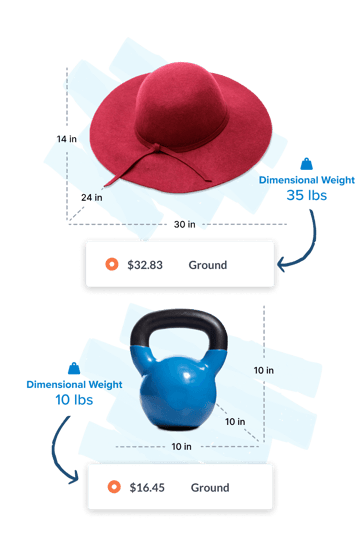
The 1-cubic-foot threshold is 1,728 cubic inches. Packages at or under that size are billed by actual weight only. Packages above that threshold can trigger dimensional weight pricing.
This is still one of USPS's clearest advantages for ecommerce merchants. UPS and FedEx apply dimensional weight more broadly, while USPS preserves actual-weight pricing for packages that stay at or below the 1-cubic-foot line.
The catch is that small measurement differences can matter. Updated USPS measurement rules round fractional dimensions up to the next whole inch. A box that measured safely under the threshold may cross into dimensional pricing territory once rounding is applied. That makes accurate carton data more important than ever.
How to Check Whether Your Packages Trigger Dimensional Weight
Start with your highest-volume SKUs and review the boxes they actually ship in. Don't rely on the product dimensions on the product page, the manufacturer's spec, or the box you wish the warehouse used.
- Measure the actual shipped carton.
- Round each dimension up to the nearest whole inch.
- Multiply length × width × height.
- If the result exceeds 1,728 cubic inches, dimensional weight may apply.
- Divide the cubic total by 139 to calculate billable dimensional weight.
- Compare dimensional weight to actual weight. You pay the higher one.
A 12 × 12 × 12 box is exactly 1,728 cubic inches. A 12 × 12 × 13 box is 1,872 cubic inches and crosses the threshold. The practical difference in the warehouse may feel tiny. The billing difference isn't.
ShipperHQ's dimensional packing logic helps calculate the most efficient box configuration per order based on your actual carton inventory. That helps avoid unnecessary dimensional weight triggers across USPS, UPS, FedEx, and regional carriers.
What Do USPS Rate Increases Mean for Ecommerce Merchants?
USPS Still Has a Small-Package Shipping Advantage
For packages at or under 1 cubic foot, USPS charges actual weight only. That can be a major advantage for ecommerce merchants shipping lightweight products in compact packaging.
A rate increase on actual weight can still be cheaper than a lower base rate calculated on dimensional weight. This is why USPS often remains competitive for apparel, cosmetics, accessories, supplements, small electronics, and other products that fit into smaller boxes or padded mailers.
Commercial USPS Rates Matter More After Each Increase
Retail rates are what a customer pays at the post office counter. Commercial rates are available through approved shipping platforms and are typically significantly lower than retail rates, depending on service, package profile, and volume.
Annual rate increases affect both retail and commercial pricing, but merchants using retail rates start from a higher baseline. Over time, that gap becomes more painful.
For most ecommerce merchants, commercial USPS pricing should be the baseline. Retail rates shouldn't be what customers see at checkout.
Ground Advantage Changed USPS Ecommerce Shipping
Ground Advantage simplified USPS ecommerce shipping by combining several older services into one economy option. That was good news for merchants, but it also means older shipping setups may need review.
If your store, ERP, OMS, or shipping rules still reference retired USPS services or legacy Parcel Select logic, your checkout may not be showing the best available service for the order.
Ground Advantage is often a strong fit for lightweight residential delivery, but it should still be compared against Priority Mail, UPS, FedEx, and regional carriers at the order level.
How Can Ecommerce Merchants Offset USPS Rate Increases?
Rate Shop USPS Services at Checkout
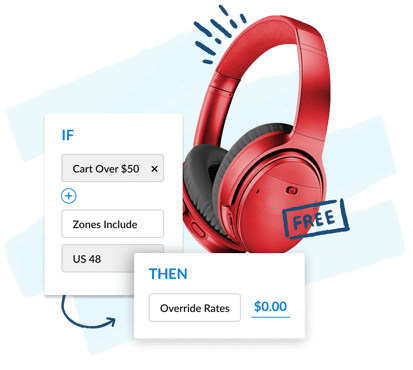
Priority Mail versus Ground Advantage is not a set-it-and-forget-it decision. A lightweight shipment going one zone may price better with Ground Advantage. A heavier shipment going across the country may price better with Priority Mail Flat Rate or another carrier entirely.
The only reliable way to choose is to compare live rates at the order level. Carrier rate shopping lets your checkout compare USPS services, UPS, FedEx, and regional carriers in real time instead of relying on static assumptions.
Keep Packages Under 1 Cubic Foot When Possible
For USPS, the 1-cubic-foot line is a real cost boundary. Staying at or under it keeps eligible packages billed at actual weight only. Crossing it can bring dimensional weight into the calculation.
That makes carton selection a margin lever. A small packaging change can sometimes avoid a dimensional weight jump without changing the product, carrier, or delivery promise.
ShipperHQ's dimensional packing logic helps determine the most efficient box configuration for each order, which can reduce unnecessary dimensional weight charges across carriers.
Use Priority Mail Flat Rate for Dense Long-Distance Orders
Priority Mail Flat Rate boxes charge the same price regardless of destination zone. For dense products that fit into Flat Rate packaging, this can create a useful ceiling on long-distance shipping costs.
Flat Rate isn't always cheaper, but it is predictable. That predictability can be valuable for merchants shipping heavy items across varied zones or offering flat-rate shipping promotions.
Compare USPS Against UPS, FedEx, and Regional Carriers
USPS may be the best option for lightweight residential packages. UPS, FedEx, or regional carriers may win for heavier items, certain zones, specific service promises, or negotiated rate profiles.
The answer changes by order. That's why cross-carrier rate shopping matters more than choosing a default carrier and hoping it stays competitive.
Make Sure Commercial USPS Rates Are Live at Checkout
If your checkout is showing USPS retail rates, you're likely overcharging customers, eating unnecessary margin, or both. Commercial USPS pricing is one of the easiest structural advantages ecommerce merchants can access.
Confirm that your shipping setup is pulling commercial rates through your platform or carrier account, and make sure those rates are live at checkout when USPS pricing changes.
How ShipperHQ Helps Merchants Manage USPS Rate Changes
If USPS is part of your carrier mix, the practical move is making sure your checkout reflects what USPS actually charges, not what it charged six months ago. ShipperHQ connects to USPS commercial rates, runs dimensional packing calculations based on your actual carton inventory, and compares USPS against UPS, FedEx, and regional carriers in real time. Each order routes to the right carrier without someone manually updating a rate table every time USPS adjusts a service, surcharge, or dimensional rule.
Start a 15-day free trial or book a demo to see how ShipperHQ handles it.
Or if you're tracking what UPS and FedEx are doing alongside USPS this year, the 2026 carrier rate increases guide covers all three in one place.

FAQs
How often does USPS raise rates?
USPS typically makes at least one annual pricing adjustment, and additional temporary or service-specific changes can happen during the year. Ecommerce merchants should review USPS rates more than once per year, especially if they rely heavily on Ground Advantage, Priority Mail, or Parcel Select.
Does USPS use dimensional weight pricing?
Yes, but not for every package. USPS charges actual weight for packages at or under 1 cubic foot. For packages over 1 cubic foot, dimensional weight can apply. That makes the 1-cubic-foot threshold especially important for ecommerce merchants shipping lightweight products.
What replaced USPS Parcel Select?
USPS Ground Advantage launched in July 2023 and replaced First-Class Package Service, Parcel Select Ground, and Retail Ground. It created one economy domestic service for packages up to 70 lbs and is now one of the most important USPS services for ecommerce merchants.
What is the difference between USPS retail and commercial rates?
Retail rates are the prices available at the post office counter. Commercial rates are available through approved shipping platforms and are typically lower, depending on service and volume. Most ecommerce merchants should use commercial rates at checkout, not retail rates.
How does the USPS Delivering for America plan affect future rate increases?
The Delivering for America plan is USPS's long-term strategy for financial sustainability, service improvements, infrastructure investment, and network modernization. Rate adjustments are part of that broader plan, so merchants should expect USPS pricing to keep changing over time.
Is USPS still cheaper than UPS Ground or FedEx Home Delivery for ecommerce?
It depends on the shipment. USPS is often competitive for lightweight packages, shorter zones, and shipments at or under 1 cubic foot. UPS, FedEx, or regional carriers may be better for heavier packages, longer zones, or specific service requirements. The most reliable answer comes from comparing live rates per order.
What USPS rate changes should ecommerce merchants watch most closely?
To keep your ecommerce shipping costs under control, you should closely watch Ground Advantage pricing, Priority Mail pricing, temporary transportation-related price changes, dimensional weight rules, package measurement requirements, and the widening gap between retail and commercial rates.
Since tracking these fluctuations manually can be a major headache, many merchants use automation platforms like ShipperHQ to dynamically update shipping logic, compare carrier options, and display accurate, cost-effective prices directly at checkout.