


USPS 2026 Policy Changes: What Merchants Need to Know About the Latest Pricing & Rules
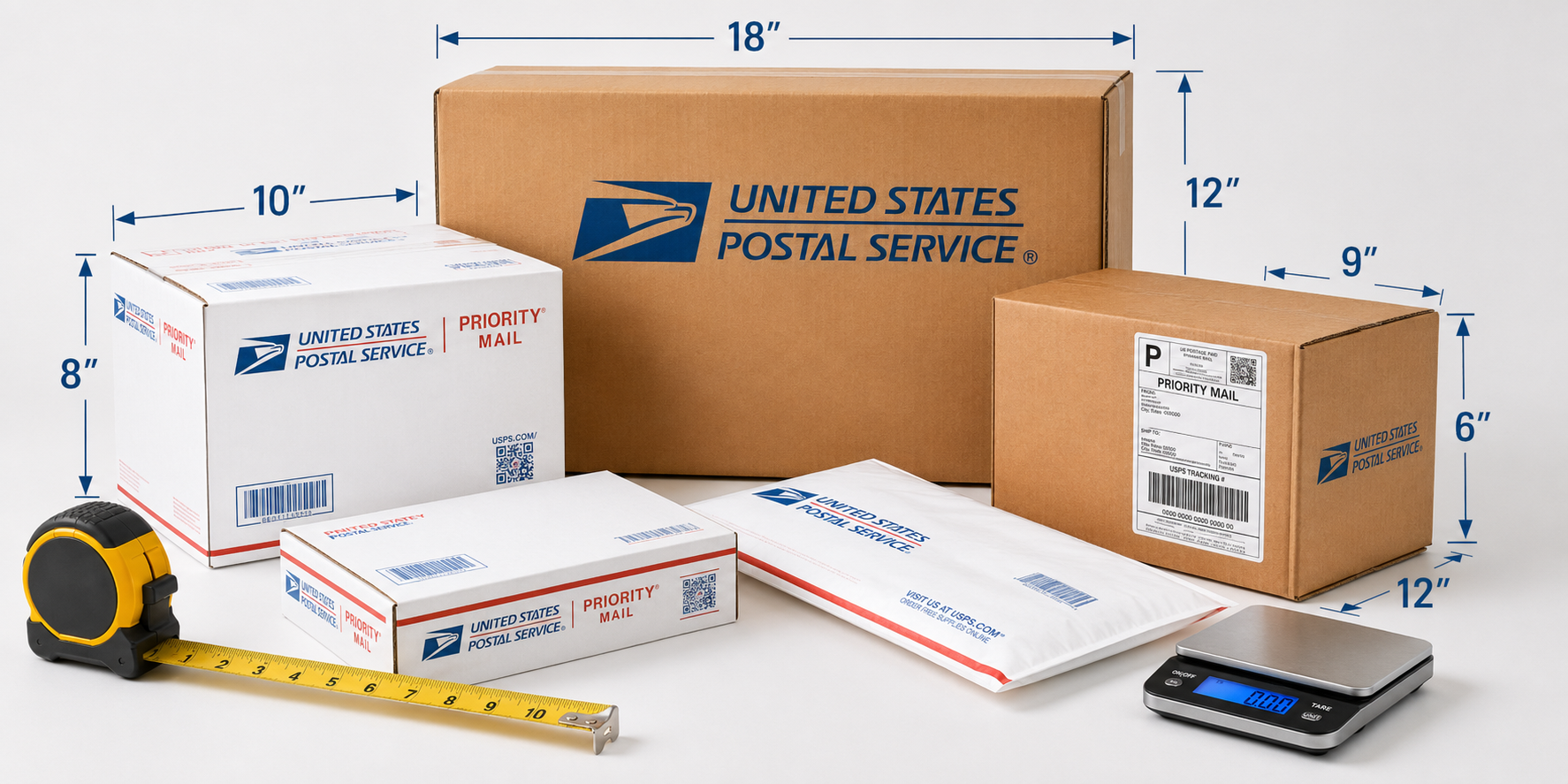
More USPS 2026 policy changes take effect July 12: USPS is changing how it measures and prices packages. This shift will increase costs for many ecommerce operators, especially those shipping bulky, but lightweight packages. Here's exactly what's changing, what it means for ecommerce brands, and exactly what actions you can take to keep it from eroding your margins.
USPS 2026 Policy Changes at a Glance
- Dimensional divisor drops from 166 to 139 for packages over 1 cubic foot, a roughly 19% increase in billable weight for the same box.
- Fractional dimensions round up to the next whole inch instead of down (e.g. 12.1" now rounds up to 13" instead of down to 12"), meaning more packages will be priced based on dimensions and rates go up
- Ounce-based commercial Ground Advantage pricing goes away for packages under 1 lb. Every package in that range bills at the 15.999-oz rate, a 36% to 43% increase depending on the zone.
- A $200 overweight or oversize fee now applies anywhere in the network, not just at the point of entry, for packages over 70 lb or 130 inches in combined length and girth.
- New HazMat handling fees: $7.50 per package for air-eligible Priority Mail and Priority Mail Express, plus a $50 noncompliance penalty for mislabeled hazardous shipments.
- The free Addresses API is retiring, with the paid replacement starting at $10/month.
Stacked together, with peak season right around the corner, these changes add up to a meaningfully different cost structure for anyone shipping small or bulky items through USPS. Let’s take a closer look at each one, and how they impact merchants.
A Change to the Dimensional Divisor Increases Costs for Packages Over 1 Cubic Foot
Dimensional weight pricing has always been about one question: does the box take up more space than it weighs? USPS answers that question with a formula:
Length × Width × Height ÷ dimensional divisor = Dimensional Weight
For any package over 1,728 cubic inches (1 cubic foot), USPS bills you the greater of actual weight or dimensional weight. As of July 12, the divisor for that calculation drops from 166 to 139. A smaller divisor means a bigger dimensional weight number for the exact same box.
Run the math and it's about a 19% jump in billable weight for package that crosses the 1 cubic foot threshold.
The New Rounding Rule Adds More Costs
USPS has also changed how it rounds package dimensions. Fractional inches will now round up to the next whole inch instead of down. A box that measures 12.2 inches used to round down to 12. Now it rounds up to 13.
USPS has always rounded dimensional weight up to the next whole pound, even a fraction of an ounce over tips you into the next pound. Now they're rounding up inches too, so a rule that used to only apply at the pound level now applies at the inch level first.
It sounds like a small change until you multiply it across a few thousand shipments a month. And a change that looks small on a single label doesn’t look so small on an invoice. It can also make boxes that were previously under the 1 cubic threshold go over the threshold, triggering dimensional weight pricing for packages that were previously based on actual weight.
A Real Example: How Much More You're Paying
Take a 16.4 x 14 x 10-inch box.
Before July 12: that 16.4-inch side rounds to the nearest whole inch, 16. Volume comes out to 16 x 14 x 10 = 2,240 cubic inches, well over the 1,728 threshold.
Under the old 166 divisor: 2,240 ÷ 166 = 13.5 lbs, rounded up to 14 lbs billable.
After July 12: that same 16.4-inch side rounds up to 17 instead. Volume becomes 17 x 14 x 10 = 2,380 cubic inches.
Under the new 139 divisor: 2,380 ÷ 139 = 17.1 lbs, rounded up to 18 lbs billable.
You're now paying for 18 lbs of dimensional weight instead of 14. Same box. Same product. Same customer.
The exact impact on your business depends on your own packaging, product weight, and shipping zones, so it's worth running your numbers rather than guessing. With a free 15-day trial of ShipperHQ, you can test your rates across any number of shipping scenarios to see exactly how these changes affect your costs.
Why Accurate Dimensional Weight Calculation Matters More Than Ever
Native ecommerce platforms like Shopify and BigCommerce don't have a strong built-in way to calculate dimensional weight, especially once a cart includes multiple items that pack together differently than they'd price separately. Without accurate product dimensions and packing logic, shipping rates don't reflect how the order actually ships, leaving merchants to undercharge or overcharge.
ShipperHQ installs directly on your existing ecommerce platform. The Dimensional Packing feature lets you configure real product dimensions, packing dimensions, and packing rules for accurate real-time rates at checkout.
The impact of getting this right shows up directly on the bottom line, as demonstrated in the Eagle Mountain Flag case study. Before installing ShipperHQ, the company was losing $1,000 a month on inaccurate shipping rates. The shipping app it used before ShipperHQ couldn’t get shipping rates right across its 27,000 SKUs. "We're not trying to make money on shipping,” said Dan Pitcher, Owner at Eagle Mountain Flag. “We just don't want to lose money on it. We want to show competitive, accurate shipping rates and ShipperHQ makes that possible.”
Ounce-Based Pricing Is Gone for Commercial Ground Advantage
This is the change that's easiest to miss and hardest to absorb if you sell small, lightweight products. USPS used to bill commercial Ground Advantage packages under 1 lb in tiers: 4 oz, 8 oz, 12 oz. As of July 12, all of that goes away. Every published commercial package under 1 lb now bills at the top rate for that weight class: 15.999 oz, no matter what it actually weighs.
A 3-ounce item now pays the same postage as a 15-ounce item. If your catalog leans toward small, light SKUs (jewelry, supplements, cosmetics, small electronics, accessories), this is the change that hits your margin the hardest.
What This Means by Zone
|
Zone |
Old Rate (Under 4 oz) |
New Rate (All Sub-1 lb) |
Increase |
|---|---|---|---|
|
Zone 1 |
$5.09 |
$6.93 |
+36.2% |
|
Zone 3 |
$5.22 |
$7.30 |
+39.9% |
|
Zone 5 |
$5.40 |
$7.69 |
+42.4% |
|
Zone 8 |
$5.89 |
$8.40 |
+42.6% |
Retail rates and negotiated enterprise commercial rates still keep sub-1-lb weight brackets. Standard commercial platform pricing, the rate most SMB merchants are actually shipping on, does not.
This is the exact spot where a lot of merchants either overcorrect (padding rates so much they scare off small-item buyers) or undercorrect (eating the increase silently). If you're on flat rates or rate tables, this is a good moment to manually update those numbers to reflect the new tier structure. If you're displaying live rates, you have more flexibility: absorb part of the increase with a rate discount, or bundle it into product pricing instead of passing the full cost onto the shipping line item at checkout.
The Shipping Rules in ShipperHQ give you the ability surcharge, discount, or route to a different carrier based on weight or product type, so a rate hike on paper doesn't have to become an across-the-board price increase for you or your customers.
The $200 Oversize and Overweight Fee Now Applies Anywhere in the Network
This is the change most likely to catch bulky-item shippers off guard, and it's not really a new fee. It's a loophole closing.
USPS has charged a $200 overweight or oversize fee for years on packages over 70 lb or exceeding 130 inches in combined length and girth (length plus twice the width plus twice the height). What's new, effective July 12, is where it applies.
Previously, if an oversized or overweight package got caught and returned to the mailer at the point of entry (your local post office or drop-off location), it was exempt. Starting July 12, that exemption goes away: any overweight or oversize package found anywhere in the postal network, not just at the counter, gets the $200 fee, and USPS also corrects the package's rate to the 70-lb minimum on top of it. The fee is typically billed automatically through carrier adjustments, and payment may be required before USPS releases the package back to the mailer or recipient.
For merchants shipping furniture, appliances, exercise equipment, patio and outdoor products, or anything else that occasionally runs long or heavy, this closes a margin of error that used to exist. A package that slipped through drop-off with an inaccurate label used to have a shot at getting caught and returned with no penalty. Now it doesn't.
Most platforms don't flag oversize risk before a label prints, so the first sign of trouble is often a $200 charge showing up on an invoice weeks later. ShipperHQ's Dimensional Packing validates dimensions against real package configurations at checkout, so oversized packages get correctly accounted for at checkout. You have control over how much of that fee you want to absorb yourself or pass to customers.
New HazMat Fees and Noncompliance Penalties
If you ship anything with hazardous, restricted, or perishable, USPS runs eight automated barcode validations on every commercially priced package as of July 12. Check USPS Publication 52 if you're unsure whether a specific product qualifies. Air-eligible Priority Mail and Priority Mail Express shipments carry a new $7.50 handling fee. Miss the label, or mislabel the package, and it's a flat $50 noncompliance penalty, non-negotiable, non-disputable.
There's a smaller, easier-to-miss penalty layered underneath that: shippers have to check a "Hazardous Materials" box during electronic label generation so the compliance indicator gets embedded in the barcode itself. Physically marking the box "HAZMAT" isn't enough on its own. Skip the digital checkbox and it's a $0.25 automated penalty, per package, even if the box is labeled correctly on the outside.
The rules also get specific by product type. Hand sanitizer is restricted to Ground Advantage surface transport and can't go international or military mail at all. Used or defective electronics with lithium-ion batteries need a "Restricted Electronic Device, Surface Transportation Only" marking and lose access to air service. Brand-new electronics in original manufacturer packaging are exempt from the HazMat designation entirely and can still ship by air.
Shipping Rules in ShipperHQ let you hide or restrict specific shipping methods for specific products, so HazMat SKUs can be automatically kept off air services or international destinations and only shown the ground methods that are actually allowed, keeping checkout compliant at a granular level.
The Free Addresses API Is Retiring
USPS is discontinuing the free Addresses API, migrating everyone to a paid version starting at $10/month. If your checkout uses address validation to prevent bad deliveries, return-to-sender loops, and the $5.40 Address Correction Service surcharge, you now need a line item for it. Small dollar amount, but worth knowing before it shows up as an unexplained line on next month's invoice.
How to Protect Your Margin Before These Rules Bite
Between the divisor change, the ounce-based pricing elimination, the oversize fee, and the HazMat rules, the new USPS policy changes touch almost every part of how a package gets measured and priced. Native platform tools weren't built to keep up with carrier changes this granular. Dimensional Packing and Shipping Rules work together to keep checkout accurate as these formulas shift, giving you the control and accuracy to stay ahead of changes like this instead of just hoping they don't hit your margins. Protecting your margin comes down to two things.
Audit Your Packaging
Pull your highest-volume SKUs and measure the actual shipped carton, not the spec sheet. Round every measurement up to the next whole inch (that's the new rule) and multiply. Anything over 1,728 cubic inches is exposed to the 139 divisor, and anything near 70 lb or 130 inches in combined length and girth is exposed to the new $200 oversize fee, anywhere in the network, not just at drop-off. A box sitting at 13 inches on one side is a candidate for resizing to 12 before your BFCM volume hits.
Audit Your Shipping Rates
Before you commit to a peak season packaging strategy, it's worth knowing exactly which SKUs and box configurations are about to cost more, not guessing. ShipperHQ's Test Your Rates tool lets you simulate any shipping scenario directly in your dashboard, so you can see the real dollar impact on your actual catalog before your BFCM volume hits, not after.
Test your rates now with a free 15-day trial of ShipperHQ and see how these changes affect your business.
FAQs
Does the new USPS dimensional divisor apply to all packages?
No. It only applies to packages over 1 cubic foot (1,728 cubic inches). Packages at or under that threshold are still billed by actual weight.
Is USPS still cheaper than UPS or FedEx for small packages?
Often, yes, for packages that stay under 1 cubic foot and under 1 lb using retail or negotiated commercial rates. The July 12 changes narrow that advantage for standard commercial platform pricing on lightweight packages, which makes rate shopping across carriers more important, not less.
How do I know if my packaging is about to trigger dimensional weight?
Measure the actual shipped carton, round each dimension up to the next whole inch, and multiply length by width by height. If the result exceeds 1,728 cubic inches, dimensional weight applies at the new 139 divisor.
What's the new HazMat fee for USPS shipments?
$7.50 per package for air-eligible Priority Mail and Priority Mail Express shipments containing hazardous materials, plus a $50 noncompliance penalty for undeclared or improperly labeled packages, and a smaller $0.25 penalty if the digital "Hazardous Materials" indicator is missing from the barcode even when the box is physically marked correctly.
Can USPS charge me the $200 oversize fee even if my package wasn't caught at drop-off?
Yes, as of July 12. Previously, packages caught and returned to the mailer at the point of entry were exempt from the fee. Now, any overweight (over 70 lb) or oversize (over 130 inches in combined length and girth) package found anywhere in the postal network is assessed the $200 fee, along with a rate correction to the 70-lb minimum.

Share this article
Related Articles

2026 Holiday Shipping Deadlines and How to Stay Ahead
Holiday Shipping Deadlines Are Critical. Your Strategy Decides the Outcome. Carrier cut-offs are non-negotiable. Miss ...

The Auto Parts Shopify Stack: 5 Apps That Handle What the Platform Doesn't
Shopify is a good place to sell auto parts. It is not, out of the box, a good place to sell a 90-pound driveshaft next ...

You Don't Need to Be Amazon to Ship Like Amazon
You've probably heard the story before: back in the early '90s, a man turned the garage of his rental house into a ...