Shipping orders across borders used to be a job only big brands could handle. Today, even smaller online stores see shoppers clicking in from various parts of the world. The catch is the extra fees, changing customs rules, and delivery promises that can slip. If you don't keep an eye on those details, your profit on each order can disappear fast.
In this article, we'll discuss every hidden international shipping cost in plain language. You'll also discover easy-to-use tools, smarter carrier choices, and checkout tips that keep customers happy. By the end, you'll have a clear playbook for shipping globally without draining your margin.
TL;DR
Ecommerce international shipping can shrink your profits fast. Hidden fees like fuel surcharges, DIM weight, and import duties – stack up quickly and when customers see unexpected costs at checkout, it can drive up your cart abandonment rates. Map every SKU to the correct HS code, run a landed-cost calculator before you publish rates, and audit invoices each week so you always know the real door-to-door cost.
Track success with four core KPIs: landed-cost accuracy, cart-to-order conversion, on-time delivery, and customs-inspection rate. Keep an eye on tightening tax rules, greener carrier lanes, and AI-driven carrier selection – each trend can push your shipping costs down even further. Most important of all, show duties and taxes upfront at checkout. When buyers see the full landed cost at checkout, cross-border orders feel just as easy as domestic ones, and your store wins the sale.
International eCommerce is a game of handling hidden expenses. Knowing every layer of the cost stack is step one to keeping more cash in your pocket.
Here's where the money really flows on an international label.
Surcharges rarely appear until the invoice lands after the parcel ships. Because they're applied as percentages, higher-value orders take the biggest hit. The solution is a weekly invoice audit and automated alerts inside your shipping software so you can spot problem lanes before labels print.
Before you publish rates at checkout, you need a clear view of landed cost – the full end-to-end expense.
Accurate landed-cost calculators pull real-time carrier data and harmonized system (HS) codes to forecast duties and taxes. Popular options include:
By feeding weight, dimensions, and destination into these tools, you'll see the delivered cost before you publish rates in checkout.
Cutting fees is only half the battle – you also need to keep parcels moving through customs.
Every SKU must map to a six-digit HS code. Misclassification triggers customs holds, fines, or both. Best practices include:
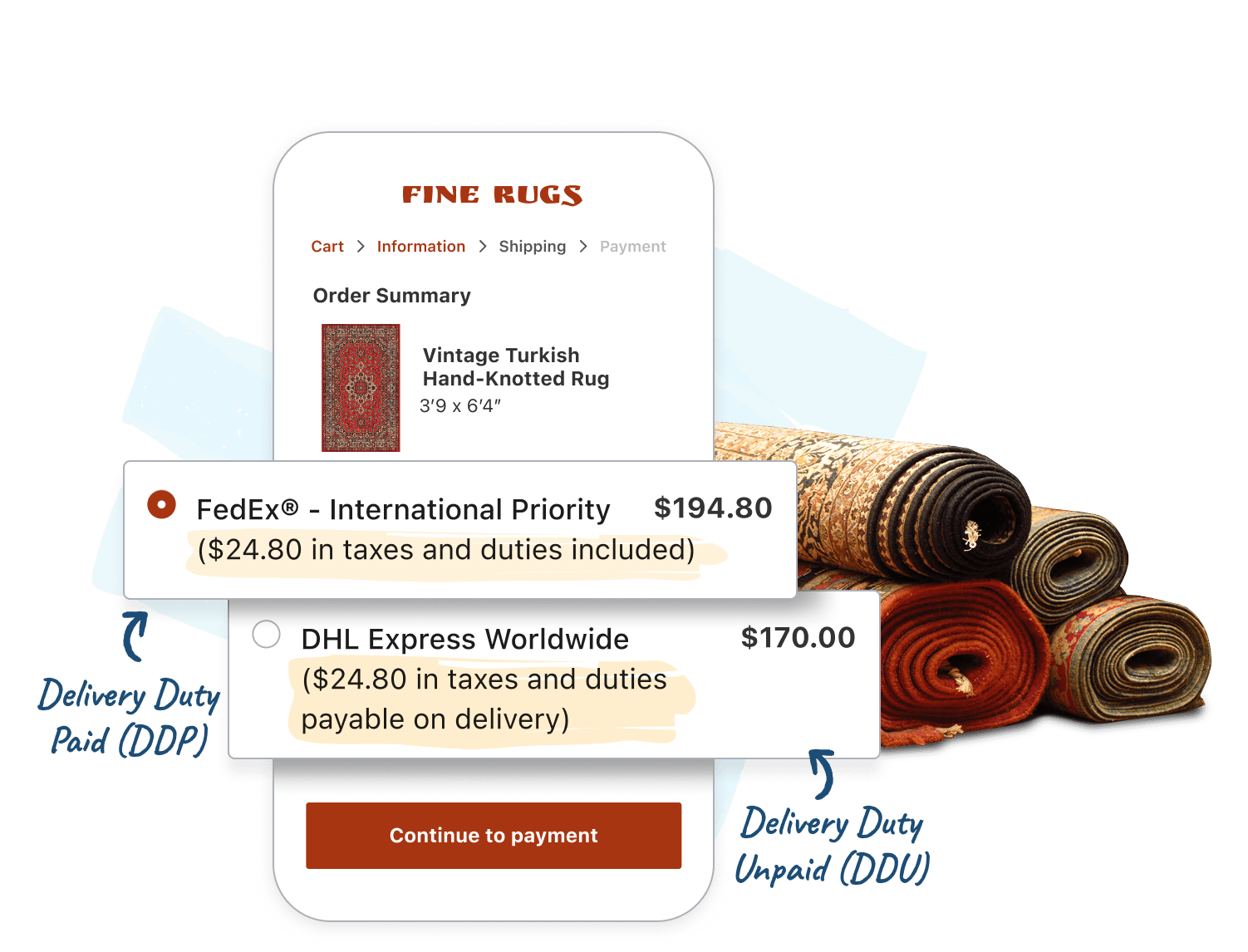
Delivered Duty Paid (DDP) absorbs import fees for a friction-free customer experience. Delivered Duty Unpaid (DDU) shifts those fees to the buyer but risks refusals.
Many merchants mix both: DDP for low-value orders to maximize conversion, DDU for high-value items to hedge against steep tariffs.
Having the right technology and smarter partnerships can cut costs when shipping internationally.
Rate-shopping software automatically pulls live quotes from postal, express, and regional carriers, then selects the most affordable service that still meets your promised transit time.
If overseas volume becomes a daily routine or your key markets sit on different continents, a 3PL with bonded warehouses can stage inventory closer to buyers, shorten transit times, and bundle customs clearance to reduce per-parcel fees.
A profitable launch starts long before you print the first label.
Review these weekly for the first 90 days, then monthly once performance settles.
The cross-border landscape is moving fast in 2025. By watching three big trend lines – regulation, technology, and sustainability – you can stay a step ahead of rising eCommerce shipping costs and even turn them into savings.
Governments worldwide are tightening low-value tax exemptions. For instance, the U.S. recently eliminated the de minimis exemption, which previously allowed low-value shipments (under $800) from China and Hong Kong to enter the US duty-free. This instantly increased duty exposure to many retailers. Staying aligned with trade news ensures you price products accurately and avoid unpleasant invoice surprises.
Carriers now offer discount incentives for carbon-neutral lanes and recycled packaging. Moreover, lightweight materials reduce dimensional weight, directly slashing eCommerce international shipping costs. Sustainability and savings can and should go hand-in-hand.
With smart multi-carrier allocation, you can spread orders across the best-performing networks in real time, slashing delays and extra fees. Additionally, duty-paid micro-fulfillment hubs keep fast-moving stock inside key markets, shielding you from sudden tariffs and shaving days off delivery windows.
Nothing sours a sale like a surprise charge at the doorstep—show the full landed cost up front, and buyers stay happy to hit "Place Order."
21% of customers abandon their cart because they can't see the total order cost upfront. Displaying the exact import charge at the checkout:
With ShipperHQ's Duties & Taxes feature, you can:
International shipping doesn't have to be a gamble. When you understand every charge in the cost stack, lean on real-time rate shopping, and collect duties and taxes before the parcel leaves the warehouse, cross-border orders start looking a lot like domestic ones – predictable, transparent, and profitable.
The merchants winning today are the ones who treat shipping as part of the customer experience, not just a back-office expense.